
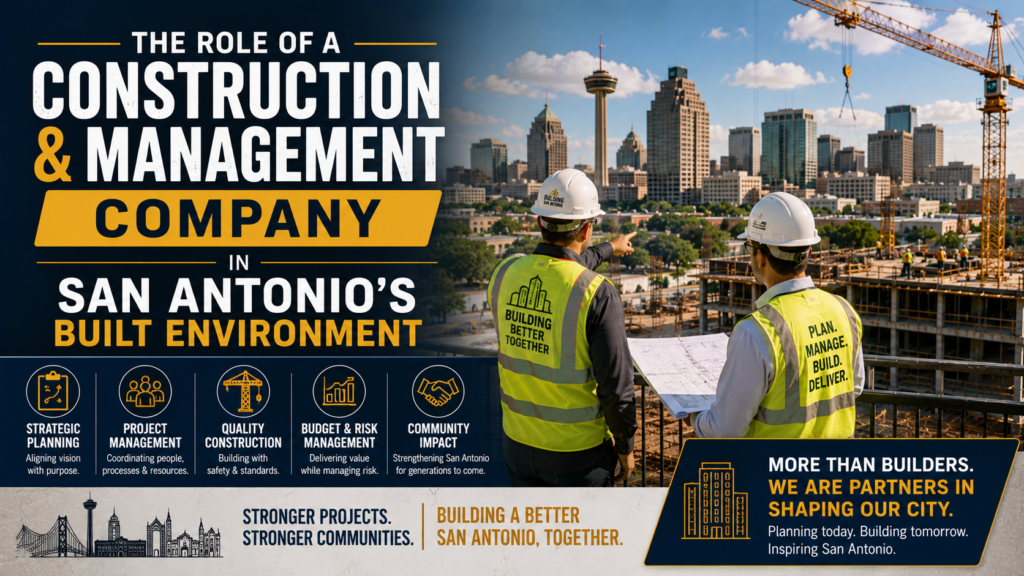
When a significant construction project comes together smoothly on schedule, within budget, meeting quality expectations, with minimal conflict it rarely happens by accident. It happens because someone with the right combination of construction expertise and management discipline was steering the project from the beginning. That combination is what a Construction and Management Company San Antonio brings to San Antonio clients who need more than muscle and equipment; they need coordination, accountability, and strategic oversight.
Understanding what construction management actually encompasses and why it is fundamentally different from simply hiring a contractor is essential for anyone planning a project of meaningful scale in San Antonio.
What Construction Management Means
Construction management (CM) is the professional discipline of planning, coordinating, and controlling a construction project from inception through completion. It involves managing the relationships among design teams, contractors, subcontractors, suppliers, regulatory agencies, and the project owner and keeping all of these parties aligned with a shared timeline, budget, and quality standard.
A construction and management company does this as an integrated function. Rather than treating construction as something that happens after design is finished and management as something that happens reactively when problems arise, a true CM firm integrates these functions from the earliest stages of project development. This pre-construction involvement is often where the most significant value is created.
During pre-construction, a skilled CM team reviews design documents for constructability identifying details that look fine on paper but would create expensive or time-consuming challenges in the field. They develop realistic schedules that account for material lead times, permit processing periods, and weather contingencies. They engage the subcontractor market to understand pricing and availability before commitments are made. By the time a shovel enters the ground, the management framework for the project is already in place.
Phases of Construction Management
Construction management operates across three broad phases, each with distinct activities and deliverables. Understanding these phases helps owners know what to expect and when.
Pre-construction is the phase most often overlooked by owners who think of construction management as a purely on-site function. During pre-construction, the CM team works alongside architects, engineers, and the project owner to develop the project’s scope in detail, establish a realistic budget based on actual current market conditions, and build out a master schedule. Risk identification happens here as well subsurface conditions, long-lead materials, permit complexity, and other factors that could affect the project are surfaced and planned around before they become problems.
Construction phase management is the on-site coordination function most people associate with project management. This encompasses daily oversight of subcontractor work, quality control inspections, schedule tracking and recovery planning when activities fall behind, safety enforcement, RFI and submittal management, change order review, and regular progress reporting to the owner. A skilled CM representative on site is the owner’s eyes, ears, and decision-making proxy throughout the construction process.
Closeout and commissioning is the final phase, covering punch list completion, systems testing, regulatory inspections and certificate of occupancy, warranty documentation, and the transfer of as-built drawings and operations manuals to the owner. This phase is often rushed, but doing it thoroughly sets up the building for trouble-free operation and preserves the owner’s rights under contractor warranties.
Why Integrated Management Matters in San Antonio
San Antonio’s construction environment has specific characteristics that make strong management especially valuable. The city’s rapid growth means that subcontractor availability is frequently constrained popular trade contractors book out weeks or months in advance. A management company with established relationships in the San Antonio market can secure quality subcontractors before availability tightens, while less connected operators scramble to fill gaps.
San Antonio’s permitting environment, while generally functional, has specific requirements and processing timelines that experienced local managers know how to navigate. Projects with complex scope those touching multiple permit types, requiring TxDOT approvals for driveway access, or involving environmental review benefit significantly from managers who have steered comparable projects through the process before.
The city’s geology adds another layer of management complexity. Rock excavation in northern and central San Antonio, expansive clay soils in other areas, and the drainage requirements associated with Hill Country rainfall all create site-specific conditions that must be identified, planned for, and managed actively throughout the project.
Design-Build vs. Traditional Delivery vs. CM at Risk
Construction and management companies in San Antonio can operate under several different project delivery models, and understanding the differences helps owners choose the structure that best fits their situation.
Traditional design-bid-build separates design from construction. The owner hires an architect or engineer to complete the design, then solicits competitive bids from general contractors. The low bidder wins the contract. This model is well-established and promotes competitive pricing but can create adversarial dynamics between design and construction teams when field conditions differ from design assumptions.
Design-build consolidates design and construction responsibility under a single entity. The design-build team is incentivized to produce a design that is efficient to build, and design decisions can be made with real-time input from the construction team. This typically accelerates schedules and reduces change order volume, though it requires the owner to trust the integrated team’s alignment of design quality with project goals.
CM at Risk is a model where the construction management firm takes on financial risk for the project’s cost, typically guaranteeing a maximum price after preconstruction is complete. This aligns the CM firm’s financial interest with delivering within budget while preserving the owner’s ability to be involved in subcontractor selection and project oversight.
Each model has appropriate applications. A construction and management company with experience across all three delivery methods can advise project owners on which structure best fits their specific project type, schedule requirements, and risk tolerance.
The Value of Local Expertise
In construction management, local knowledge is not a soft advantage it is a concrete operational asset. A management team that knows San Antonio’s subcontractor market understands which firms are reliably on schedule, which have capacity, and which should be avoided for specific work types. Local knowledge of material suppliers means faster problem-solving when something is backordered or defective. Familiarity with city inspectors, permit processes, and code enforcement patterns reduces administrative delays.
San Antonio’s construction market also has its own culture its pace, its communication norms, its expectations around relationships and reliability. Construction management companies that have operated in this market for years navigate that culture naturally, while out-of-market firms often spend time learning lessons that experienced locals already know.
Conclusion
A construction and management company in San Antonio provides something beyond physical construction capability it provides the organizational intelligence and professional discipline that transforms a complex, multi-party building project into a controlled, predictable process. For owners planning projects in San Antonio’s active, demanding construction environment, that combination of skills is not supplementary to the work; it is what makes the work succeed.